Beyond the Donor Wall: Creative Ways to Recognize Donors & Teams Throughout Your Facility
Donor recognition has traditionally meant one wall in one lobby with names listed in order of gift size. Today’s organizations have far more design options for honoring donors, staff, volunteers, and community partners throughout an entire facility, connecting each contribution to the mission it supports.
For organizations planning a capital campaign, a renovation, or a new facility, recognition can extend well beyond a single wall. Weaving it into the environment gives donors and volunteers visibility that scales with the true scope of their support.
What Story Should Donor and Team Recognition Tell?
Every recognition program should start with a decision about who’s being honored and why. Capital campaign donors, employees, volunteers, founders, board members, and community partners each carry a different relationship to the organization, and that relationship should guide how recognition looks and where it appears throughout a facility. A program built around a single campaign’s top donor calls for a different design decision than one meant to honor decades of staff service or a broad base of community partners.
Getting clear on the who and why up front gives the design team a foundation to build from. It also helps avoid a common problem: a recognition plan that works well for one group of honorees, but runs short on room or budget for the next.
What Are the Alternatives to a Traditional Donor Wall?
A donor wall is one tool among several ways to recognize the people behind a project. Naming opportunities, dimensional installations, displays woven into the visitor journey, and digital or tangible signage each give organizations a way to carry a donor’s presence through a facility.
Second Harvest Food Bank of Central Florida‘s Orlando Distribution Center shows this approach at scale. Creative Sign Designs created a donor recognition wall stretches nearly 25 ft across the building’s lobby, spelling out the “Building Solutions to Hunger” campaign name and brushed aluminum lettering. Corporate sponsors are recognized separately on 18-by-18-inch plaques placed in rooms throughout the building, and dimensional acrylic letters spelling “HOPE” extend the recognition into a broader environmental graphic design program built around the food bank’s mission.
The result gives donors and sponsors visibility tied to the specific spaces their support helped create.
How Does Recognition Become Part of the Built Environment?
Recognition reads as intentional when a design team plans it alongside the building’s architecture, interiors, wayfinding, and brand standards from the start. Bringing an environmental graphic design team into the process early lets recognition placement respond to a building’s finishes and circulation patterns.
Feeding Tampa Bay’s corporate headquarters in Tampa started as an exterior signage project and grew into something bigger. Once the organization brought CSD’s environmental graphic design team into the interior program, donor signage needed to reflect several donor-level levels and sit naturally within the building’s finishes. CSD worked directly with the team to position donor recognition alongside custom room naming and exterior directional signage, tailoring each element to the surrounding architecture.
When Should Organizations Plan for Recognition?
Recognition planning belongs in the planning phases of a capital campaign, alongside decisions about budget and meeting opportunities. Starting early gives the design team room to align donor ties and physical locations well ahead of construction.
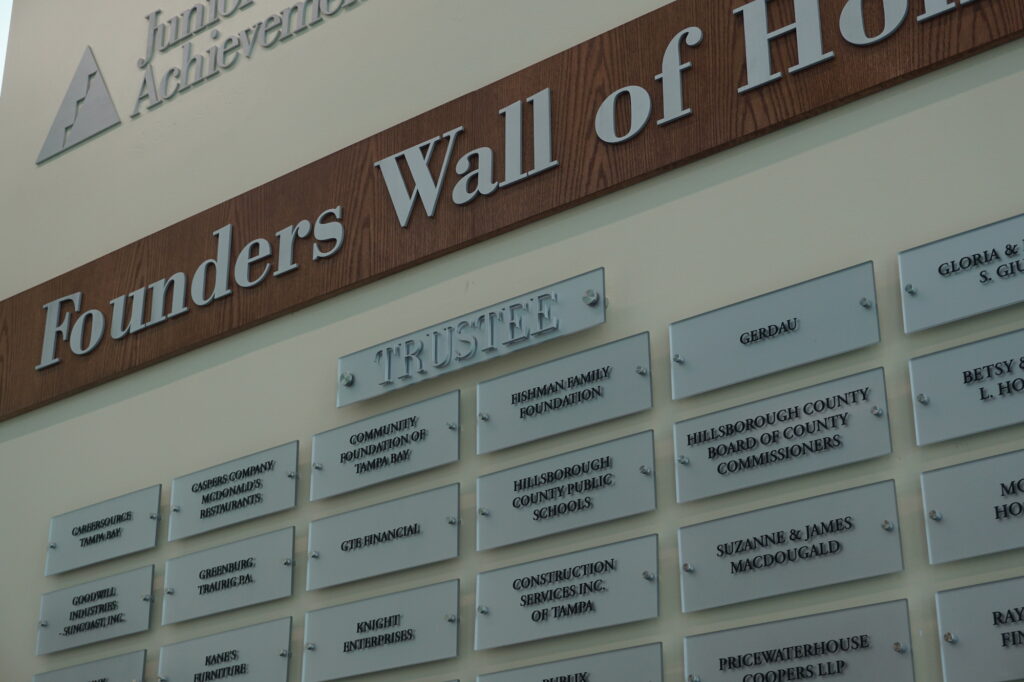
Junior Achievement Tampa Bay planned recognition into its Finance Park campus expansion from the start. CSD provided more than 25 signs across the campus, alongside a Founders Wall of Honor, a four-tier plaque system built from brushed aluminum and acrylic with stainless standoffs, recognizing the donors behind the expansion. CSD also fabricated a custom monument sign built partly from bricks salvaged during construction, giving the SunTrust Foundation’s support for a permanent presence tied to the campus itself.
Planning recognition from day one let the signage program grow with the project, with space built in for additional names as the campaign progressed.
How Does Recognition Connect Donors to Impact?
Recognition works best when it connects a donor’s name to the outcome their support made possible. Pairing individual recognition with their broader mission or history narrative helps visitors understand what a contribution built within the larger organization.
The Carol Jenkins Barnett Pavilion for Women and Children at Lakeland Regional Hospital illustrates this well. CSD’s donor package includes dimensional letters identifying areas throughout the facility and individual acrylic plaques with polished aluminum stand-ups. Tempered glass panels commemorate community contributions in additional spaces across the building.
Alongside that package, a History Wall traces the hospital’s growth back to 1916, giving individual donor recognition a place within the institution’s larger story. Donors who see their names connected to that kind of history tend to understand their gift as part of something ongoing, beyond a single plaque.
Where Should Your Organization Start?
A recognition program deserves a seat at the same table as signage, wayfinding, and environmental graphic design planning. A design-build partner brought in ahead of construction can carry that coordination through the rest of the project, whether it’s a new build or a multiphase renovation.
CSD works with community and nonprofit organizations and healthcare systems across the country to plan, design, fabricate, and install recognition programs built to grow alongside a mission. Reach out to Creative Sign Design’s team to start planning your facility’s recognition program.