Material Intelligence in EGD: Solving Design Problems Without Compromising the Vision
In a well-executed branded environment, every surface, wayfinding element, and dimensional sign seem to agree and create one cohesive system. Getting there requires honoring a designer’s vision despite real-world conditions, budgets, and performance requirements that all pull in different directions.
This is where material intelligence becomes the deciding factor in an EGD program: knowing how a material performs under real conditions, what it costs at scale, and what it can be made to convincingly resemble when the original spec won’t hold up.
EGD is More Than Aesthetics, It’s a System
Environmental graphic design governs how an entire property feels and functions, so materials have to perform across varying conditions and repeated use at scale.
Interior and exterior environments place very different strains on the same material, since a finish or mounting method that holds up indoors can fail once exposed to weather and structural loads outdoors.
Brand vision, architectural context, and signage performance are often in tension. A logo that looks crisp on a brand deck may demand mounting depth the facade can’t support, or a finish the local climate won’t tolerate.
Material selection works best as part of the initial design conversation rather than a production detail after the fact, since the earlier the fabricator understands the design intent, the more of it survives into a buildable spec.
Reading the Environment Before Selecting a Material
A single EGD program often spans wildly different conditions, from a climate-controlled lobby directory to an open-air parking structure to an exterior monument sign in direct sun. Each has its own performance threshold.
Outdoor materials have antagonists. UV exposure fades pigments, salt air accelerates corrosion in coastal Southeast markets, wind drives fatigue on larger panels, and moisture warps organic materials behind poorly sealed mounts. The mounting surface is also critical, since brick, stucco, and glass curtain wall each require different anchoring and sealing approaches.
For freestanding and facade-mounted signage above certain size or weight thresholds, most jurisdictions mandate a structural engineering review, with wind load calculations under ASCE 7 or local code determining the gauge and anchoring depth a sign needs.
The Aluminum Problem and the Creative Solution
Aluminum is a fan favorite material among EGD designers. It holds clean edges, stays rigid at thin gauges, resists corrosion, and takes finishes from brushed to anodized to painted. It’s a permanent, architectural look few materials can match alone.
But that look comes with a price tag, and fabrication is where the budget really moves. Welded assemblies, specialty finishes like anodizing, and thicker structural gauges can push the cost well past acrylic once, and recent tariff-driven price swings on raw aluminum only add to that pressure. A small per-unit premium becomes a significant budget line once a dimensional element repeats across a portfolio.
A finish applied with the right technique can solve this without touching the substrate. Multi-step metallic paint systems, when color-matched and tested under real lighting, replicate the depth and brushed texture of aluminum on a fabricated acrylic base convincingly enough to hold up under close inspection.
The most valuable engineering can creatively problem-solve for what carries the design, whether it’s appearance, weight, or durability, rather than defaulting to the cheapest substitute available. Done right, the design intent stays intact, the budget holds, and no one touring the finished space can tell the difference.
When “Wood” Can’t Actually Be Wood
Branded environments in multifamily and student housing increasingly lean on natural materials to soften an otherwise all-metal-and-glass space. You’ll likely see it in renderings for leasing offices and lobby wall features because wood grain signals warmth and residential comfort.
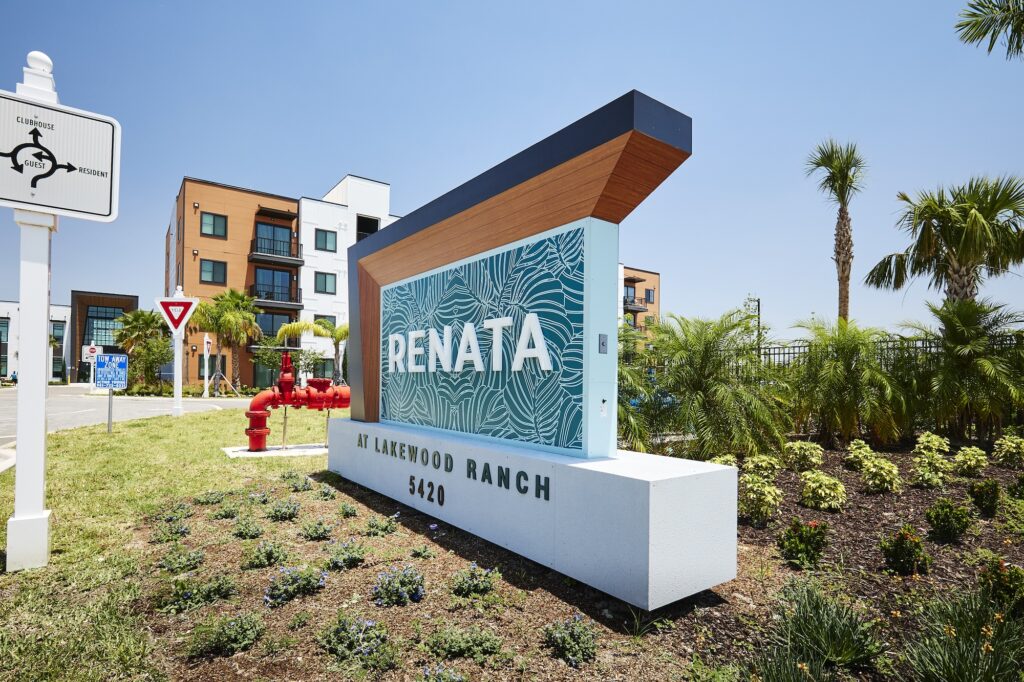
Real wood can fail in high-traffic, high-humidity, or exterior applications, so sometimes a faux wood-grain finish is needed to achieve the intended feeling. Wood responds to humidity by shifting, expanding, and eventually cracking, and when used in high-traffic applications, it takes on scuffing and oil transfer from constant touch. Direct sun causes graying within a few years even with sealant, and moisture intrusion invites rot on exterior surfaces. Its varying wood grain also makes consistency difficult across a multi-building program.
Faux wood grain separates the visual story from the structural one, delivering the desired warmth and authenticity while meeting the longevity requirements of that environment. Creative Sign Designs uses innovative solutions, like layered staining and graining techniques, sometimes paired with a printed grain pattern under protective laminate, to match stable substrates like aluminum composite, PVC, or HDU to specific wood species and grain direction.
Finish as a Design Language
Design can be communication, and finish can be a type of “design language.” It communicates your brand personality on its own terms, independent of color, logo, or typography, and it’s often the first thing someone registers about a sign before they read it. For example:
- Brushed metal = precision
- Matte finish = approachability and legibility
- High gloss = visual punch for identity moments when you want to draw the eye
Layering or mixing materials within a single sign element are storytelling tools that create a depth a flat application can’t compete with, and some signage moments warrant a heavier finish investment than others. A feature wall meant to anchor a lobby gets more attention than a directional panel in a back hallway. Deciding where that investment belongs is itself a design decision that benefits from upfront fabrication input before the budget is set.
The Value of Early Material Conversations
Every material decision we covered—the wood grain that’s actually a finish on a stable substrate or the aluminum that turned out to be acrylic—prove that solving for what the design needs creates the best outcomes. Every choice is purposeful, in terms of both aesthetics and function.
Creative Sign Designs incorporates this work into every EGD project. We push to be part of the design and planning conversation so we can solve design and budget challenges with craft and creativity before the spec is locked. If you’re ready to work with a true EGD fabrication partner, reach out.